
The Northern Flicker is a year round resident in North Carolina. It is a brown and white woodpecker with a red spot on the back of its neck, the nape. It has a very bold black mark above a speckled breast and the male has a black 'mustache'.
It has been a few years since I have seen them visit my yard. Yesterday as I was about to let my dog out into the backyard I saw two Northern Flickers ground feeding! Nice surprise! Tivo had to wait until they finished looking for food before I let her out. The Northern Flicker is the only woodpecker to habitually eat from the ground preferring ants and grubs and such. I watched as these two welcome visitors found and ate what appeared to be grubs from my yard. I wondered why I don't see them more often in my yard as they are here year round but it may be that in the winter I get the northern migrants. Regardless of where they come from and how long they stay they are a welcome sight!
Showing posts with label backyard birding. Show all posts
Showing posts with label backyard birding. Show all posts
Tuesday, January 13, 2015

Saturday, January 10, 2015
Bird Feeders Continued

It only took me a few minutes to cut the wire and fix the suet inside.
 I hung the suet up next to the other bird feeder and was excited to see a Gold Finch in his winter colors come to visit! In fact I do believe a male and female Gold finch were the first visitors!
Bird Feeders

There are 7 types of feeders basically. They are as follows: globe, haven, hopper, platform, suet basket, tubes and window feeders. The most popular and most expensive is the 'haven' feeder. I would guess it gets its name from the idea that it is a safe place for small birds to eat as it keeps large birds of prey out with the metal cage. It also keeps the squirrels out of the food. It is a tube feeder with a metal cage around it. The cage limits the size of bird that can feed. In my area, Raleigh, NC, I would suggest black-oil sunflower seed and a quality mixed seed that would attract Nuthatch, Chickadee, Tufted Titmouse, Finches and Sparrows.
The 'hopper' and 'platform' feeders will attract the widest variety of birds. The feeder in the picture is not a 'hopper' as the feed drops continuously as it is eaten but it attracts a large variety of birds also. I have seen all the small birds use it along with Cardinals and a Red-bellied Woodpecker. In either the 'platform' or 'hopper' feeder black-oil sunflower and a good quality seed mix are good choices. The 'platform' would also handle some fruit for the fruit lovers of the air!
If anything is know about backyard birds it is that the American Gold Finch loves thistle! The thistle sock is best suited for these brightly colored birds but there are thistle tubes also. Go with your own preference.
I will leave the remaining feeders for the next post. I hope I have given you enough food for thought to hold you over to the next writing! I promise it will come soon!
Sunday, January 4, 2015
The Birds are Back!
I have had the opportunity to see a lot of bird activity since I last wrote. I don't know where they go or why they go, probably because they can, but they are here now! This is who I have seen these last 2 weeks.
* Sharp-shinned Hawk, sitting on the fence, 7 A.M.
* Dark-eyed Junco, feeding on the ground around feeder, about 12 to 15 birds, 9:30 A.M.
* Purple Finch, at feeder, 10 A.M.
* Also all the regulars mentioned earlier
* Sharp-shinned Hawk, sitting on the fence, 7 A.M.
* Dark-eyed Junco, feeding on the ground around feeder, about 12 to 15 birds, 9:30 A.M.
* Purple Finch, at feeder, 10 A.M.
* Also all the regulars mentioned earlier
Friday, December 19, 2014
Bird Journaling
Oh where are the birds? I have food out. There is a source of water. Where are the birds? Is that something you find yourself saying; 'where are the birds?' I do. And that is one of the many reasons I journal about 'my' birds. If I don't take the time to write about their visits to the yard I forget how often they do come and the variety of species I have seen in my very own backyard! So I confess I am a bird watcher. I am also a keeper of a bird journal. I am not as faithful to my journal entries as I would like to be, but I do keep a journal that helps me keep up with the birds that visit my yard. I find that when I am too busy to journal, I am too busy to stop and look for the birds! I do not want to be too busy to stop and watch for the birds; they are nature. We are nature. Together we with the birds, the trees, the wind, the rain, the bugs, the everything put together are nature; we are the world around us.
Bird journals should not be confused with the scientific notes called 'field notes'. Bird journals are personal and should, in fact need to have the personal insights of the person jotting down what is seen. One would of course want to know what the date of the entry is including the year. Sometimes I forget to put the year and then when I go back to read over some of the entries I get a bit confused as to what year I am reading about! The time of day and the weather conditions are also important. Where you are is important. Is it your backyard? a park? a city street? Then of course what are the birds doing? Eating? Flying? Floating on the water? Fighting? Birds are very territorial.
Identify the bird! The most difficult task! What bird is it that you are watching? Some birds are easy to identify such as the red Cardinal or the yellow Gold Finch. Some are a bit more tricky such as the Sparrows! There are so many different species under the title Sparrow I am still trying to figure out these little guys and gals; who is who?
If you decide to journal do it your way. Don't worry about spelling or grammar. Draw a picture of the bird if it helps you. I often like to use pencil for my entries. Some people like a special pen. I like to write at the kitchen table in the morning with my cup of coffee. That is one of the best times to see the birds in action; the morning. Sometimes I am very reflective other times I simple jot down who came to visit. The gift of taking time to journal is the gift of sight and sound. When you take time to write about what you see and hear it actually causes you to truly 'see' and 'hear'. The journal will help you to become more observant. You will become more aware of the world around you. You will begin to understand the relationship of cause and effect more deeply. I would hope you would become more aware that we are the world around us. The 'we' meaning nature and all her beauties and us. And we are the most responsible for nature as we are at the top of the food chain; we have the ability to plan and think for the future and to change if we need to. We are a part of the world around us and this world does not belong to us.
Bird journals should not be confused with the scientific notes called 'field notes'. Bird journals are personal and should, in fact need to have the personal insights of the person jotting down what is seen. One would of course want to know what the date of the entry is including the year. Sometimes I forget to put the year and then when I go back to read over some of the entries I get a bit confused as to what year I am reading about! The time of day and the weather conditions are also important. Where you are is important. Is it your backyard? a park? a city street? Then of course what are the birds doing? Eating? Flying? Floating on the water? Fighting? Birds are very territorial.
Identify the bird! The most difficult task! What bird is it that you are watching? Some birds are easy to identify such as the red Cardinal or the yellow Gold Finch. Some are a bit more tricky such as the Sparrows! There are so many different species under the title Sparrow I am still trying to figure out these little guys and gals; who is who?
If you decide to journal do it your way. Don't worry about spelling or grammar. Draw a picture of the bird if it helps you. I often like to use pencil for my entries. Some people like a special pen. I like to write at the kitchen table in the morning with my cup of coffee. That is one of the best times to see the birds in action; the morning. Sometimes I am very reflective other times I simple jot down who came to visit. The gift of taking time to journal is the gift of sight and sound. When you take time to write about what you see and hear it actually causes you to truly 'see' and 'hear'. The journal will help you to become more observant. You will become more aware of the world around you. You will begin to understand the relationship of cause and effect more deeply. I would hope you would become more aware that we are the world around us. The 'we' meaning nature and all her beauties and us. And we are the most responsible for nature as we are at the top of the food chain; we have the ability to plan and think for the future and to change if we need to. We are a part of the world around us and this world does not belong to us.
Quiet!
It has been very quiet out back! No bird activity at the feeders and only a few sparrows spotted at the back of the yard. I am wondering why it is so quiet. The weather has been good; mild and no rain. The day I had all the activity at the feeder we had a good rain late morning. I am wondering if the weather is the connection to the quiet or did they eat all the "good stuff" from the feeders and have gone to another somewhere? Or perhaps they are coming later in the morning after I have left for work? I will just keep watching and buy some better bird seed!
Tuesday, December 16, 2014
Look! Over there!
Look! Over there! What? I don't see anything! If you are going to do any kind of bird watching you need a good pair of binoculars. Even if you are watching the birds at your feeder from your window a good pair of binoculars will help you to identify one feather friend from the other. It is great fun to get to know who is coming for dinner! You may even spot a rare bird!
You don't have to break the bank to get a good pair of binoculars for bird watching. However you should spend enough to get glass lenses that are slightly coated. You can tell if they are coated by holding the binoculars under fluorescent light. The lens should look purple or amber. If it looks clear or white it is not coated properly.
The power of the binoculars is written somewhere on the pair and is expressed with a number in front of an X. The number tells how many times the object will be magnified; example 7X means the object will be 7 times bigger in your field of vision. Usually 7x or 8x is enough for backyard birding.
The number after the x represents how much light is let in the binoculars. The more light, the larger the number, the better you will be able to see the image under low light conditions. The average is 30 or 35. The other number, usually below the x, represents the field of view for the image you are looking at or for! The larger the number, the larger the field of view which permits easier and quicker spotting. This number can be shown as degrees or width in feet when something is 1,000 yards away. Small numbers represent a narrower field for viewing which eliminates extraneous details but makes it more difficult for focusing. The novice would benefit from a wider field of vision.
Two other considerations when buying a pair of binoculars: weight and eyepiece comfort. Large binoculars can be heavy and cause you to shake after a few minutes which will leave you looking for the bird that got away! There are also eye piece options such as soft rubber around the lens. Whatever pair you choose be sure to test them at the store for a good, comfortable fit as a good pair will last a very long time and will bring you many wonderful birding outing even in your own backyard!
You don't have to break the bank to get a good pair of binoculars for bird watching. However you should spend enough to get glass lenses that are slightly coated. You can tell if they are coated by holding the binoculars under fluorescent light. The lens should look purple or amber. If it looks clear or white it is not coated properly.
The power of the binoculars is written somewhere on the pair and is expressed with a number in front of an X. The number tells how many times the object will be magnified; example 7X means the object will be 7 times bigger in your field of vision. Usually 7x or 8x is enough for backyard birding.
The number after the x represents how much light is let in the binoculars. The more light, the larger the number, the better you will be able to see the image under low light conditions. The average is 30 or 35. The other number, usually below the x, represents the field of view for the image you are looking at or for! The larger the number, the larger the field of view which permits easier and quicker spotting. This number can be shown as degrees or width in feet when something is 1,000 yards away. Small numbers represent a narrower field for viewing which eliminates extraneous details but makes it more difficult for focusing. The novice would benefit from a wider field of vision.
Two other considerations when buying a pair of binoculars: weight and eyepiece comfort. Large binoculars can be heavy and cause you to shake after a few minutes which will leave you looking for the bird that got away! There are also eye piece options such as soft rubber around the lens. Whatever pair you choose be sure to test them at the store for a good, comfortable fit as a good pair will last a very long time and will bring you many wonderful birding outing even in your own backyard!
Backyard birding
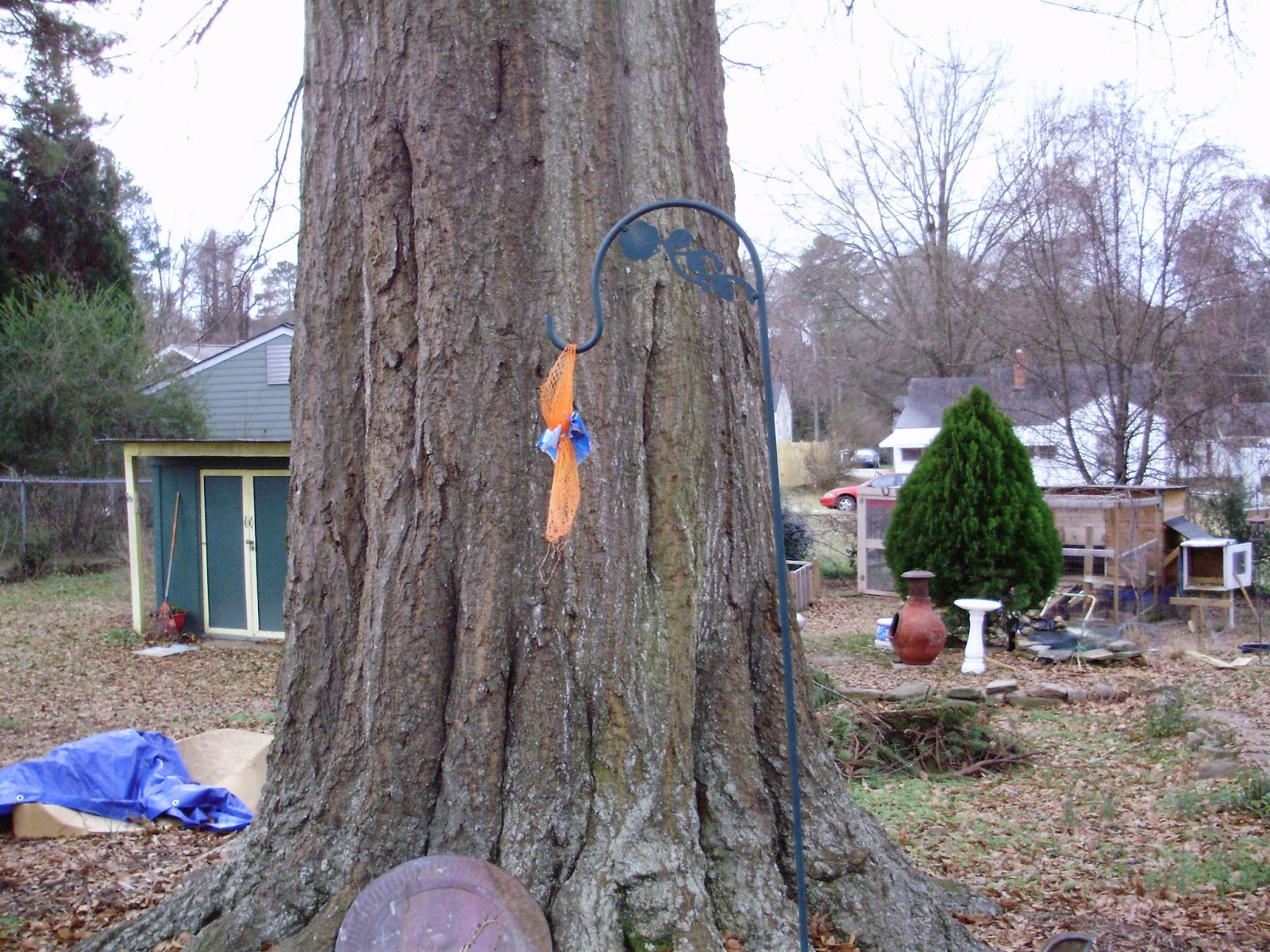
 Today I begin writing about birding in the backyard. As I begin this journey I keep in mind what I recently read about blogging: it is not about opinion but it is about viewing the world in a certain way and sharing that view with others. My view often centers around what is happening in my very own backyard. I am very fortunate to have a good size yard with a very large, old Oak tree which is inviting to the birds and a great source of shade for me in the summer!
Today I saw the following birds visit my simple plastic bird feeder:
- a pair of Blue birds! The first sighting in my yard this season!
- a pair of Brown-headed Nuthatch
- several Tufted Titmouse
- one female Red-bellied Woodpecker
- several Carolina Chickadees
- a variety of Sparrows
I am preparing several workshops to be given at the garden center where I work. I will be using my blog to help me get my ideas together and share my thoughts with anyone who happens to pass by this way! May it be helpful to you and me!
As always the journey continues!
Subscribe to:
Posts (Atom)